PB Comms wins Agency of the year at the 2026 MAX awards
Now Available:
PB Comms wins Agency of the year at the 2026 MAX awards
At this year's MAX Awards, PB Comms won Agency of the year, a category voted by the Financial Standard editorial team. The award recognises agencies specialising in media, public relations or creative services that have driven strong growth and measurable results for their financial services clients. A big congratulations to the whole PB Comms team for always going above and beyond.
Australian workers are generally optimistic, notably about their work and health. However, there is growing concern about their long-term financial prospects, with particular attention to challenges in retirement planning. This is according to Fidelity International’s Global Sentiment Survey.
The annual survey, conducted with 38,000 respondents across 35 markets including US, Japan, mainland China, Brazil, the UK, Saudi Arabia and Australia, aims to analyse the sentiment of working adults towards their finances, health, work and life.
According to the research, 65 per cent of Australian workers are mostly optimistic about the next six months while 23 per cent are feeling pessimistic. However, when compared to responses from around the world, Australians are slightly below the average, where 69 per cent of global respondents say they are optimistic. They are also less optimistic that others in the APAC region in particular India (86 per cent optimistic) and China (85 per cent optimistic).
72 per cent of Australian workers say that cost of living/impact of rising inflation is causing them stress, compared to an average of 64 per cent in the Asia Pacific region. The next highest cause of stress is the state of the economy (60 per cent) followed by global geopolitical events (55 per cent). Meeting long-term financial goals (53 per cent) and saving enough for retirement (51 per cent) were also of concern.
Simon Glazier, managing director of Fidelity International says there are signs that Australians are more concerned about the economic outlook and geo-political volatility, and more affected by cost-of-living pressures, than their counterparts in other countries. “Most people, including in Australia, feel their work, personal lives and health are in good shape but are less confident about their overall finances, and less confident still about their retirement planning. The research highlights that financial confidence is higher in the short-term, such as managing immediate personal finances and debt, than it is for longer term, including planning for the future and retirement planning.”
“In particular, Australian workers are more likely to say they feel stressed by cost-of-living issues, and more likely to have reduced their savings levels over the past year, than the global average. This could be driven by factors such as fears about housing affordability, or broader concerns about the concentration of the stock market and a potential AI bubble which would affect retirement savings in superannuation,” Simon Glazier says.
Around two-thirds of Australian workers describe their work/life balance as very or quite good (66 per cent), followed by work at 65 per cent and physical health at 62 per cent, with mental or emotional health and personal and social life close behind (both at 60 per cent).
The area of most concern is retirement planning, with just 43 per cent saying this is very or quite good.
“When it comes to retirement there is almost an equal number of Australians who feel ‘confident’ and ‘not confident’ about being financially comfortable in retirement (36 per cent vs 32 per cent),” Simon Glazier says. “This is despite Australia having a well-established superannuation regime that is looked up to by many other countries.
“It is clear that market volatility and uncertainty is playing a role in this. Many Australians say they haven’t changed their approach to saving/investing for retirement over the past six months (43 per cent). However, of those who have changed their approach, the reasons given are revealing – 18 per cent say they have put more money towards investments because they believe the stock market will do well, while 10 per cent have put more into cash because they are worried about volatility. This shows there are very mixed views about the outlook for markets.”
The research also looked at whether people are planning to change their retirement timeline as a result of events in the past six months.
While two-thirds of 50+ year workers say they haven’t changed their plans (66 per cent), 27 per cent say they will retire later than expected and just seven per cent say they will retire earlier. Of these, the main reason for retiring earlier is to provide care for a family member (34 per cent). 25 percent are retiring earlier because of ill-health or physical impairment, and 21 per cent were made redundant and couldn’t find another job. Just 30 per cent are retiring earlier because they have enough saved and can afford to.
For those who think they will retire later than expected, the main reason is that their retirement savings are not as much as they expected (41 per cent) followed by the fact that they enjoy work so want to keep working for longer (32 per cent).
Cost of living pressures are also having a direct impact on people’s financial situation, with savings levels in Australia taking a hit.
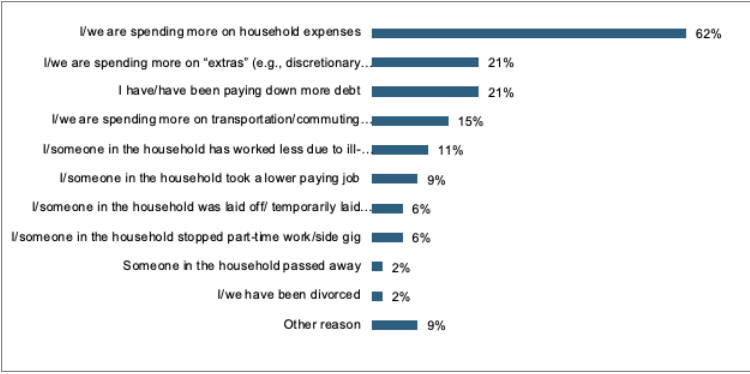
Table 1: Why have you saved less in in the past six months?
The research shows that Australian workers are more likely to have saved less in the past six months (28 per cent) than to have saved more (23 per cent) and the main reason given for saving less is rising household expenses (62 per cent).
“This is by far the biggest response – the next highest is 21 per cent who are spending more on ‘extras’ such as discretionary or luxury spend. Globally, the only other country that is spending more on household expenses, and therefore saving less, is Japan (63 per cent). Furthermore, those Australians who have saved more over the past six months say that the main reason is that they are spending less on extras (49 per cent). The message is that Australians are spending more on essentials, and less on luxuries, compared to their global counterparts,” Simon Glazier says.


.jpg)
.jpg)
.jpg)


